Start Building Products
From Software Engineer to Product Engineer. The Mindset Shift You Need.
What is Vibe Coding?
Vibe coding is a new approach to software development where AI handles most of the coding, while humans focus on describing what they want. Instead of writing every line manually, you give the AI a high-level prompt, and it generates the necessary code. If there’s an error, you simply ask the AI to fix it.
The concept was popularized by Andrej Karpathy, a leading AI researcher and former Director of AI at Tesla. He describes vibe coding as
“fully giving in to the vibes” a workflow where you trust AI to do the heavy lifting while you guide it with natural language commands.
Vibe coding is not just about using AI tools like GitHub Copilot or ChatGPT to autocomplete functions; it’s about shifting from writing code to orchestrating AI to build software. The goal is to create faster, focus on problem-solving rather than syntax, and make programming accessible to more people, including those without traditional coding backgrounds.
The Karpathy Effect: How One Tweet Shook the Coding World
Karpathy’s posts on X about vibe coding have sparked intense discussions. He suggests that AI coding assistants are getting so good that developers should stop thinking in terms of “writing code” and start thinking about “guiding AI.”
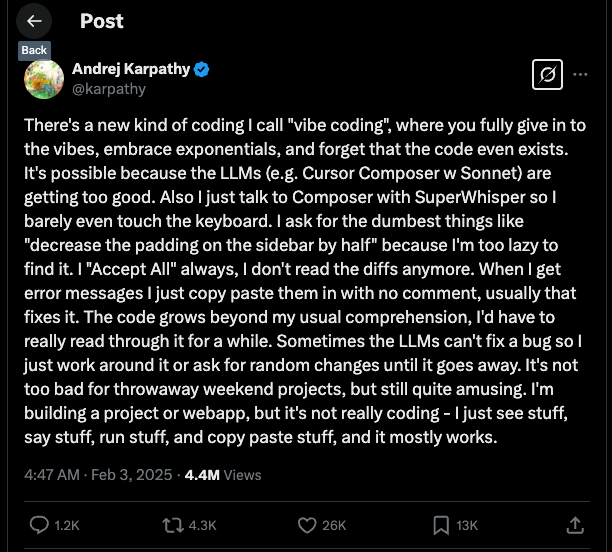
Karpathy’s Perspective
His argument is simple: software engineering has always been about automation, so why shouldn’t we automate coding itself? Instead of manually typing functions and debugging line-by-line, developers should:
- Describe what they need in plain language.
- Let AI generate the code.
- Review, refine, and test it.
Why This is Blowing Up on X?
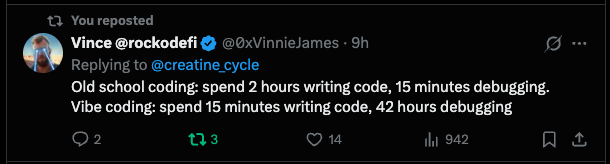
Many developers resonate with this, calling it the next big shift in software engineering. However, not everyone agrees. Skeptics argue that blindly relying on AI could lead to poorly understood, difficult-to-maintain code.
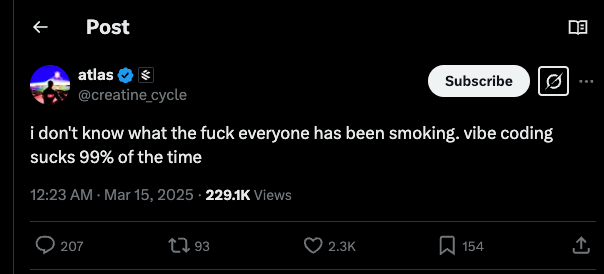
A common concern is that developers will lose critical problem-solving skills, just as GPS navigation has made people worse at reading maps. But proponents argue that being able to instruct AI effectively will become the most valuable skill of the future.

Why Should You Care? The Vibe Coding Revolution is Here.
If you’re a software engineer, vibe coding could change how you work forever. It’s no longer about memorizing every programming language’s syntax. Instead, it’s about
thinking in terms of systems, user needs, and product development.
How Vibe Coding Impacts Developers?
- Speed: AI can generate, debug, and optimize code faster than a human.
- Creativity: Less time spent on repetitive tasks means more focus on innovation.
- Accessibility: Even non-coders can now build software with the help of AI.
- Higher-level Thinking: Instead of thinking like a coder, you start thinking like a product builder who focuses on solving real-world problems.
Traditional vs. Vibe Coding Approach
Scenario: Building a Chatbot
- Traditional approach: You need to research chatbot frameworks, write code for handling user inputs, connect APIs, and manually test responses.
Press enter or click to view image in full size

- Vibe coding approach: You simply prompt an AI tool: Create a chatbot using Python with OpenAI’s API. It should answer general questions and store conversation history in a database. AI then generates most of the necessary code, which you refine and deploy.
This approach allows you to build solutions faster rather than getting lost in implementation details.
The Great Mindset Shift: From Software Engineer to Product Engineer
Imagine two developers: Alex and Jamie.
x1, a traditional software engineer, prides himself on clean code, algorithm efficiency, and writing everything manually. He spends hours perfecting logic and debugging by hand.
x2, a product engineer, thinks differently. Instead of obsessing over syntax, Jamie focuses on the end goal: building a great product. She uses AI to generate code, troubleshoot errors, and quickly iterate on ideas. When given a project, she doesn’t ask, “How do I write this function?” Instead, she asks, “What’s the best way to solve this problem?”
This is the key difference: x1 writes code. x2 builds products.
The mindset shift is about moving from the micro (perfect code) to the macro (great product).
Vibe coding accelerates this shift, forcing developers to think more like product engineers.
Mastering the Vibes: Skills and Tools for a Product Engineer
To thrive in this new era, you need to develop new skills and embrace the right tools. Here’s what matters:
Key Skills:
- Prompt Engineering: Knowing how to give AI clear, effective instructions.
- System Design: Understanding how different components fit together in an application.
- Critical Thinking: Being able to assess and refine AI-generated code.
- UX/UI Awareness: Since AI can handle the backend, front-end experience becomes more crucial.
Essential Tools:
- AI-powered IDEs: GitHub Copilot, Cursor, and Replit AI.
- Low-code and no-code platforms: Bubble, Retool, and Superblocks.
- AI Debugging Assistants: ChatGPT, Codeium, and Tabnine.
FAANG Prep and CS Degrees: Are They Now Dead?
Not necessarily — but their value is shifting. Algorithm-heavy whiteboard interviews and deep CS theory were once the gold standard for getting top jobs. Now, companies care more about:
- Can you build and ship a product?
- Can you leverage AI effectively?
- Can you think in terms of user experience and problem-solving?
CS fundamentals still matter,
But spending years grinding Leetcode might not be the best investment anymore. Instead, learning how to use AI tools efficiently might give you a bigger career boost.
Adapt or Get Left Behind: What Happens If You Ignore Vibe Coding?
If you ignore this shift, you risk falling behind. Developers who refuse to use AI will find themselves at a disadvantage compared to those who can build faster and smarter with AI assistance.
Example: Job Market Impact
Imagine two developers applying for a job:
- Candidate A: Spends weeks coding everything manually and debugging by hand.
- Candidate B: Uses AI tools to generate code, troubleshoot issues, and deploy a working product in half the time.
Which one do you think the company will hire? AI-assisted development is simply too efficient to ignore.
Embracing the Future of Coding
Vibe coding isn’t just a trend — it’s the future of software development. AI is no longer just a tool for automation; it’s becoming a co-developer. The best engineers of the future won’t be the ones who write the best raw code. They’ll be the ones who know how to turn ideas into products quickly using AI.
If you want to stay ahead, start adapting now. Learn how to work with AI, shift your mindset from coding to product-building, and embrace the future before it leaves you behind.
Playbook form @peterwong_xyz
Press enter or click to view image in full size

https://x.com/peterwong_xyz/status/1898090027873452542